Wang Xing once said that first-rate people do things, while second-rate people judge what others do. Judging is at the heart of an investor's work. However “second-rate” that may be, evaluating what others do is itself the work of investing. What matters is learning to do it better and better.
Over the previous two years, I spent a great deal of time improving my intellectual abilities, hoping to get as close as I could to the level of outstanding founders. Over the past year, reflecting on my life and observing others, I have increasingly come to feel that inner strength matters more in entrepreneurship. Building a company is a founder's own practice of self-cultivation, a process that continually tempers the heart and mind.
As I currently understand it, inner strength has two essentials: learning to loosen the ego's grip on how we judge things, and cultivating equanimity.
To assess, as an observer, how someone else's practice of self-cultivation is going, the first question ultimately has to be about my own practice.
The judging mind
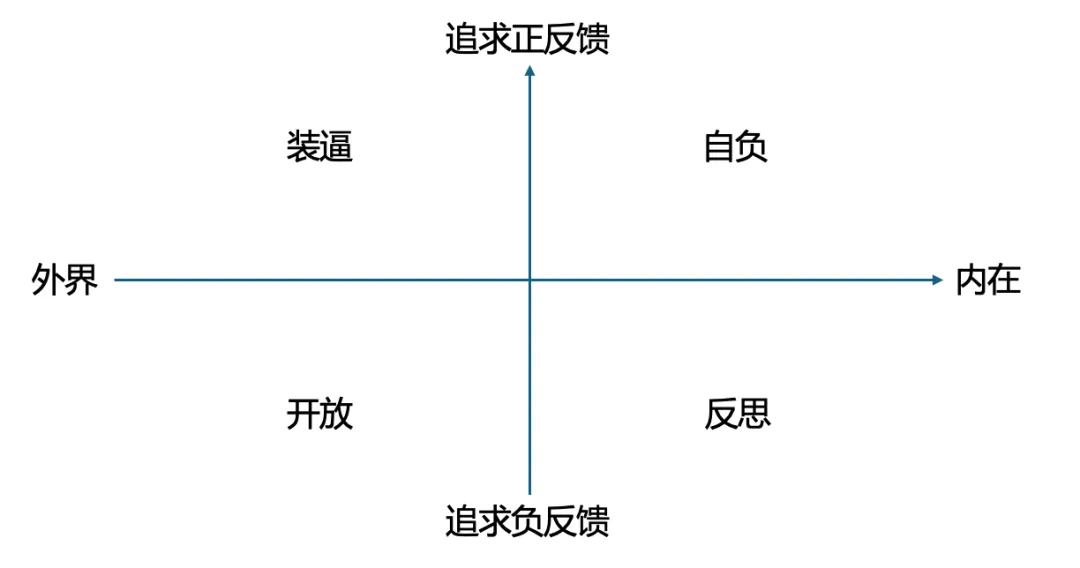
At the heart of the judging mind is the ego. Thinking more deeply about it, though, I have found that the ego expresses itself along two different dimensions.
We are social animals. Like other animals, we are reluctant to expose our weaknesses, be vulnerable, or receive negative feedback. But we are also different: we pay attention to a wider social world, because part of the meaning of each person's existence is defined by their connections with others.
Robert Kegan's theory of adult development describes several ways of making sense of the world that evolve as people grow:
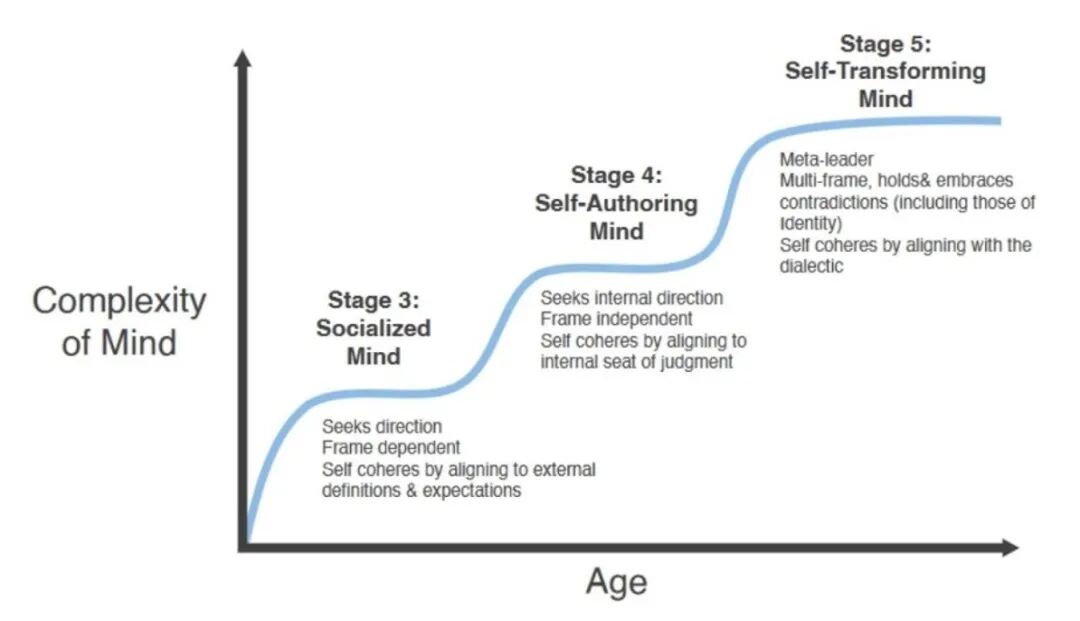
The self-sovereign mind
People at this stage live in a world centered on “me,” with only two sides: me and everyone else, what I want and what others want. They might, for example, throw a tantrum when their needs are not met. Their thinking does not involve right or wrong, whether others are struggling, or even how others see them. There is only “I want.” Children and adolescents generally exhibit this way of thinking, but around 5% of adults remain at this stage.
The socialized mind
People gradually move away from self-centeredness, begin to accept others' opinions and perspectives, and tend to explore the world through those perspectives or through external theories. They become fully integrated into and assimilated by their environment, adeptly following its rules and institutions as the only proper way to conduct themselves.
The self-authoring mind
People begin to develop their own standards and internal system for making decisions. They follow that system in making choices and are less likely to become stuck in inner conflict because of tensions around them. Authority shifts from the external to the internal.
The self-transforming mind
When self-authoring individuals begin to question whether their decision-making system applies universally, they begin to move toward the self-transforming stage. At this stage, people can attend to the whole system and everyone within it. They are less inclined to see the world in binaries or polarized terms, and can look at a problem from different people's perspectives in search of common ground. If self-authoring often carries a sense of “I am right,” self-transforming moves toward “I may be wrong.” People can stay aware of their own internal decision-making system and adjust it when needed, remaining continually open to growth.
To me, the thread running through adult development theory is a movement from the small world we currently see toward a larger, more authentic one. This evolution also unfolds along two dimensions: shifting our attention from the self to “the world plus me,” and shifting it from positive feedback toward negative feedback. These are two ways the ego expresses itself, and two directions in which we can work against its pull.
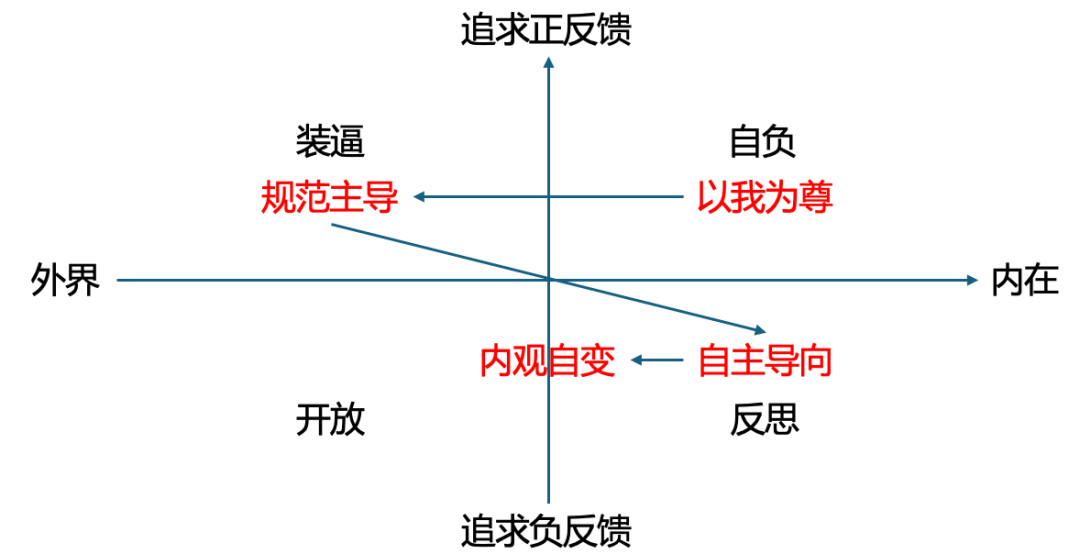
Something I have gradually come to understand over the past few years is that I used to experience relatively little inner turmoil because I paid almost no attention to external feedback. I had a strong sense of self and great confidence in the quality of my own reflection. Yet that also shut down a channel through which I could receive negative feedback from the world. It was another expression of ego, one that kept me from seeing a larger world. I now believe the best approach is to find a way to face external criticism and pain, rather than avoid them. That leads to the second aspect of inner strength: equanimity.
Equanimity
One of my favorite questions to ask founders is what major setbacks they have experienced in their lives. Behind that question is my belief in the Buddhist idea that “affliction itself is awakening.” As Wang Defeng puts it, Chinese philosophy is a philosophy of life. Without the necessary lived experiences and life stories, especially pain and hardship, no amount of reflection alone can bring an understanding of the principles behind them. It is also difficult to cultivate equanimity without those experiences.
Friends who read fortunes and birth charts once told me that life unfolds in ten-year phases, and that ages 18 to 28 would be the low point of mine. Starting university did indeed mark the most painful period of my life: I felt lost and let the time slip away. Even now, I still dream about sitting a final exam with my mind completely blank. But now that I have emerged from that low, I find something different in those experiences each time I look back:
- In my final year of university, I began reflecting for the first time on the painful experiences of the previous few years. I came to understand two things. First, I did not enjoy pattern-recognition work with a low ceiling; I wanted a vocation that could hold my boundless aspirations. Second, I needed to acknowledge my own imperfections.
- Later, through internships and work, I met many people my age who were driven by deep fixations, and I saw the pain they carried inside. I suddenly understood that my past suffering had become nourishment for growth, sparing me much inner anguish as I continued to develop. In that moment, I understood the simplest, most basic truth in “Reversal is the movement of the Dao; yielding is the way of the Dao.” I also fully accepted the imperfections of my past.
- Later still, as my life gradually got back on track, I came across Wang Defeng's statement that “Chinese philosophy is a philosophy of life.” I understood why the wisdom of our ancestors could be written in books and read by so many, while so many still did not understand what it meant. Only after living through such a cycle yourself do you come to trust that what you are seeing is a real pattern. Just as someone who has experienced an economic cycle may be calmer when the next one arrives, having lived through a cycle in my own life will help me meet the next with greater equanimity and accept my future imperfections. This “ordinary mind,” as equanimity is called in Chinese, rests on the world's simplest patterns. Yet truly living through them and coming to trust them is difficult.
- A recent insight came from reading Zhang Jinjian: steadiness comes from trust, just as equanimity comes from trusting the rhythms of the Dao. Our emotions rise and fall just as life does. Through its sweet, sour, bitter, and spicy moments, maintaining inner steadiness requires something we believe in. Life is about experience, so experiencing pain and negative emotions is also a distinctive part of being alive. It is part of intimacy, and part of life. This is what I believe. It is also how I feel about my feelings: another dimension of equanimity.
Looking back, I no longer regret the choices I made. If I could start again, I would make the same choices. I love my past self, my present self, my future self, and myself as I am.