This piece grew out of a question I have been thinking about this year, one that had troubled me for a long time. Ever since I came to understand what “connecting the dots” means, a sense of equanimity has freed me from a great deal of inner pain and struggle, which is wonderful. Yet it has also trapped me in a comfort zone. I kept feeling that I would eventually find my way onto a path that was meant for me, giving myself all kinds of excuses. As a result, I seemed unable to give anything my absolute best. Where had I gone wrong?
As the answer began to become clearer recently, I happened to see that Duan Yongping had also recommended Roger Federer’s commencement speech at Dartmouth, so I read it again. Reading it last year and rereading it now felt completely different. What struck me most was that the very first lesson, “Effortless is a myth,” was right there in the heading.
Last year, I had completely overlooked the significance of that sentence. I had focused only on Federer’s second lesson, which deepened my understanding of equanimity.
- Effortless is a myth.
- It’s only a point.
- Life is bigger than the court.
It’s Only a Point
What stayed with me most from the speech last year was the difference between Federer’s match-winning percentage and his point-winning percentage:
In tennis, perfection is impossible... In the 1,526 singles matches I played in my career, I won almost 80% of those matches... Now, I have a question for all of you... what percentage of the POINTS do you think I won in those matches?
Only 54%.
In other words, even top-ranked tennis players win barely more than half of the points they play.
...
When you’re playing a point, it is the most important thing in the world.
But when it’s behind you, it’s behind you... This mindset is really crucial, because it frees you to fully commit to the next point… and the next one after that… with intensity, clarity and focus.
The truth is, whatever game you play in life... sometimes you’re going to lose. A point, a match, a season, a job... it’s a roller coaster, with many ups and downs.
And it’s natural, when you’re down, to doubt yourself. To feel sorry for yourself.
...
The best in the world are not the best because they win every point... It’s because they know they’ll lose... again and again… and have learned how to deal with it.
You accept it. Cry it out if you need to... then force a smile.
You move on. Be relentless. Adapt and grow.
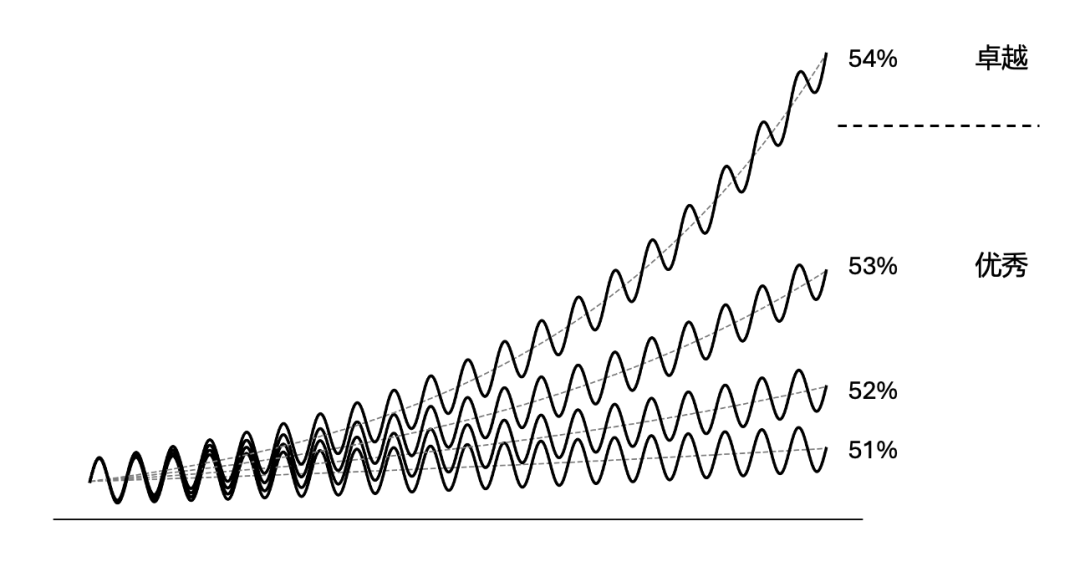
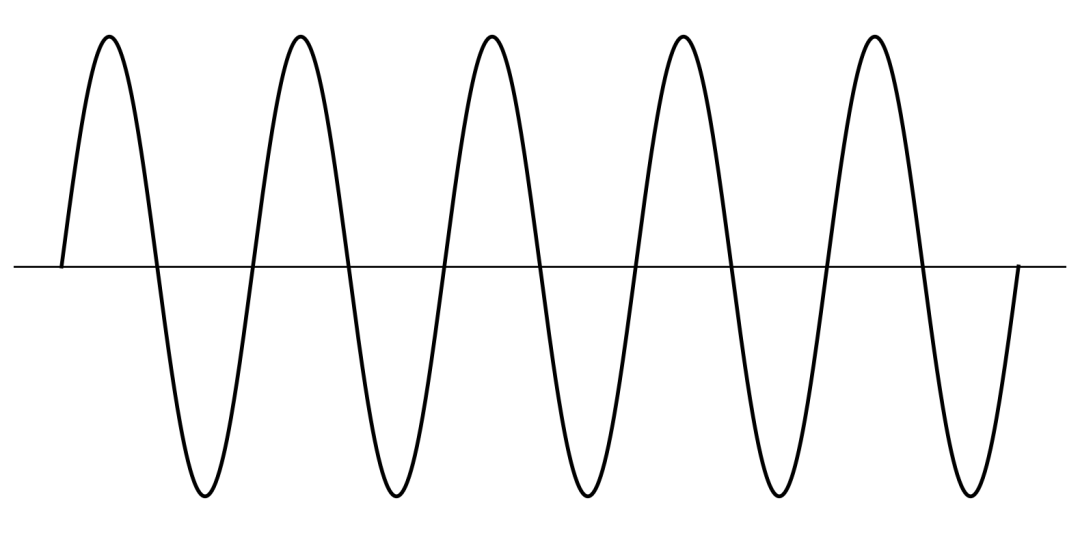
My understanding last year was that even by winning only 54% of the points, he still won 80% of his matches. What mattered, then, was to reset after every point, win or lose, and play the next one well. Equanimity matters: we should not let the inner turmoil of a momentary gain or loss affect the outcome of the entire match. Life rises and falls like a sine wave.
Effortless Is a Myth
I have recently been reading Creativity, Inc., about Pixar. Two of the principles they believed in were “story is king” and “trust the process”:
The other principle was “trust the process.” We believed in it because it gave us a sense of security: difficulties and mistakes are inevitable in any complex creative endeavor, and we often find our way through them as we work.
As they put “trust the process” into practice, they also began to question it and arrive at a new understanding:
We were equally confident in the principle of “trust the process,” but the process itself did not save Toy Story 2. “Trust the process” had gradually morphed into “assume that problems will work themselves out in the process.” It certainly gave us much-needed comfort, but it also tempted us to let down our guard, become passive, and even lose our sense of cohesion.
Once I understood this, I told everyone that the phrase was meaningless. It distracted us and kept us from doing the concrete work of solving problems. I told them that we should trust people, not the process. A “process” cannot plan a schedule or exercise artistic judgment. It is merely a tool that provides us with a framework. To do good work, maintain discipline and achieve our goals, we have to take on more responsibility and exercise more initiative.
In my view, however, we must be wary of allowing trust to tempt us into neglecting our responsibilities. Once we fall into that trap, we will simply keep repeating familiar approaches, producing work that is hollow and devoid of new ideas.
In 2000, director Brad Bird joined the Pixar family. One of his favorite sayings was: “The process can either make you or break you.” I tend to agree with Brad, because he recognizes both the power of a process and the role of human initiative within it. Katherine Sarafian, a producer who has been at Pixar since Toy Story, told me that rather than “trusting” the process, she finds it more useful to “guide” it: examine how things are progressing, identify the gaps, then attack them forcefully to make sure the problems are solved in one go. Here, it is people who exercise agency, not the process itself.
Reading this, I finally understood my own problem: I had handed over my agency to the process and neglected my ability to take initiative. A healthy approach recognizes the power of the process and draws inner strength from it, while also recognizing the need to act within that process and hold ourselves to high aspirations.
In Li Xiang’s recent interview with Luo Yonghao, Li also described a counterintuitive trait of exceptional entrepreneurs. Once they have chosen the right direction and taken a long view, they do not pursue perfection or work slowly and patiently. Instead, they iterate at an extremely high frequency, obtaining feedback and growing through frequent rounds of reinforcement learning with the real world.
That extremely rapid iteration, together with Federer’s stories of rigorous training in “Effortless is a myth,” taught me a sobering lesson. Both are expressions of initiative. Equanimity may make you good, but only when combined with initiative can it make you exceptional.
Another way to look at Federer’s example is this: to win 80% of the matches, he had to win 54% of the points—not 51%, not 52%, and not 53.6%. The effort put into every point is also what determines that final 80% win rate.