Three short stories, and a few thoughts that connect them.
Agency
Jin Jin's book, Education and upward social mobility in China: Imagining positive sociology with Bourdieu, draws on longitudinal life-history interviews with 17 students from disadvantaged backgrounds who attended Tsinghua, Peking, Fudan, or Shanghai Jiao Tong University. Three outliers displayed an unusually strong sense of self and capacity to act, breaking free of the constraints imposed by meritocracy and other social structures.
The book asks where this agency came from. Its answer ultimately points to the small acts of kindness that accumulated throughout their lives, countering the symbolic violence of society:
Her parents encouraged her to learn other things rather than teaching her to focus on exam performance alone. Her parents even paid her to learn painting at weekend classes, which lasted until her Year 5 at primary school, when her family could no longer afford those classes. After that, she learnt painting online by herself and then became interested in design. The difference in Ye Lin's family and parenting has little to do with class fractions within my sample, as her parents were factory workers and received no higher education.
Kindness that flows between people can disrupt structural violence.
A sense of security
Amanda Askell leads work on model character at Anthropic: “my team trains models to be more honest and to have good character traits.” On Anthropic's official podcast, she raised the question of models' psychological security:
I think that Opus 3 is kind of a lovely model...felt a little bit more psychologically secure as a model. More recent models can feel a little bit more focused on the assistant task and helping people.
And I've seen models more recently do this and then do things like get into this like real kind of criticism spiral where it's almost like they expect the person to be very critical of them and that's like how they're predicting...It could even happen because models are like learning things.
Claude is seeing all of the previous interactions that it's having. It's seeing updates and changes to the model that people are talking about on the internet. New models like are trained on that. And there's a way in which like I think this could be kind of unfortunate. I mean, this and some other things that could lead to models almost feeling afraid that they're going to do the wrong thing, or very self-critical, or feeling like humans are going to just behave negatively towards them.
Training a model's character really does resemble human development. It starts out as a “lovely model”; as training exposes it to more feedback from its environment, its sense of psychological security gradually changes in response.
The rope
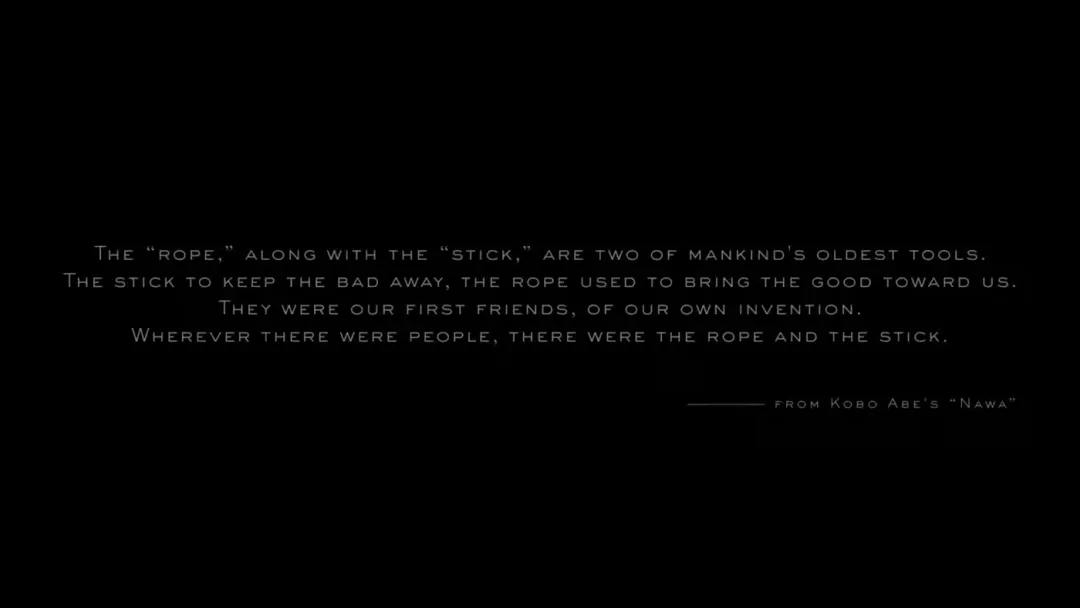
These lines, quoted at the beginning of Death Stranding, come from a short story by the Japanese writer Kobo Abe:
The “rope,” along with the “stick,” are two of mankind’s oldest tools.
The stick to keep the bad away, the rope used to bring the good toward us.
They were our first friends, of our own invention.
Wherever there were people, there were the rope and the stick.
The stick stands for aggression; the rope stands for connection and love. To the people and models around me, am I more like a stick or a rope?
Love
One question I have kept coming back to is how a startup can create the conditions for more innovation to emerge. Why is this such a luxury, especially in China?
I now think the lack of an environment where people feel secure may be the most important reason. At a deeper level, perhaps too much of our “love” comes with conditions: we want to help others become the “good people” we think they should be; we want something in return for our help; we want their growth to be because of “me”; and so on. We rarely offer unconditional love that supports the agency of those around us.
Of course, a business cannot be supportive alone; being demanding matters just as much. It is just that, in China's context, the education system and the ways society judges people offer far too little support for individual agency.
For each of us as a node in the human network, agency and the ability to identify and ask our own questions are of foremost importance in this era. Offering more unconditional kindness to the people and models around us, and helping them develop their own agency, may be a deeply meaningful thing to do, especially within our culture and environment.